

Pretreatment Design for High-Turbidity Seawater RO Systems
seawater reverse osmosis (SWRO) is widely used to produce freshwater from seawater in coastal areas, islands, offshore facilities, and industrial projects. However, seawater quality can vary significantly depending on location, season, weather conditions, and marine environment.
Among various seawater challenges, high turbidity is one of the most common factors affecting SWRO operation. Seawater with high levels of suspended solids, sediment, organic matter, algae, and other impurities can create serious problems for RO membranes if proper pretreatment is not applied.
Pretreatment is not simply a filtration step before reverse osmosis. It is an essential engineering process designed to protect RO membranes, stabilize feed water quality, reduce fouling risks, and improve long-term system performance.
For high-turbidity seawater applications, engineers must carefully design the pretreatment system according to raw water conditions, seasonal changes, required recovery rate, membrane selection, and operational requirements.
A reliable pretreatment design allows SWRO systems to operate more efficiently even under challenging seawater conditions.
Why Pretreatment Is Critical for High-Turbidity Seawater RO Systems
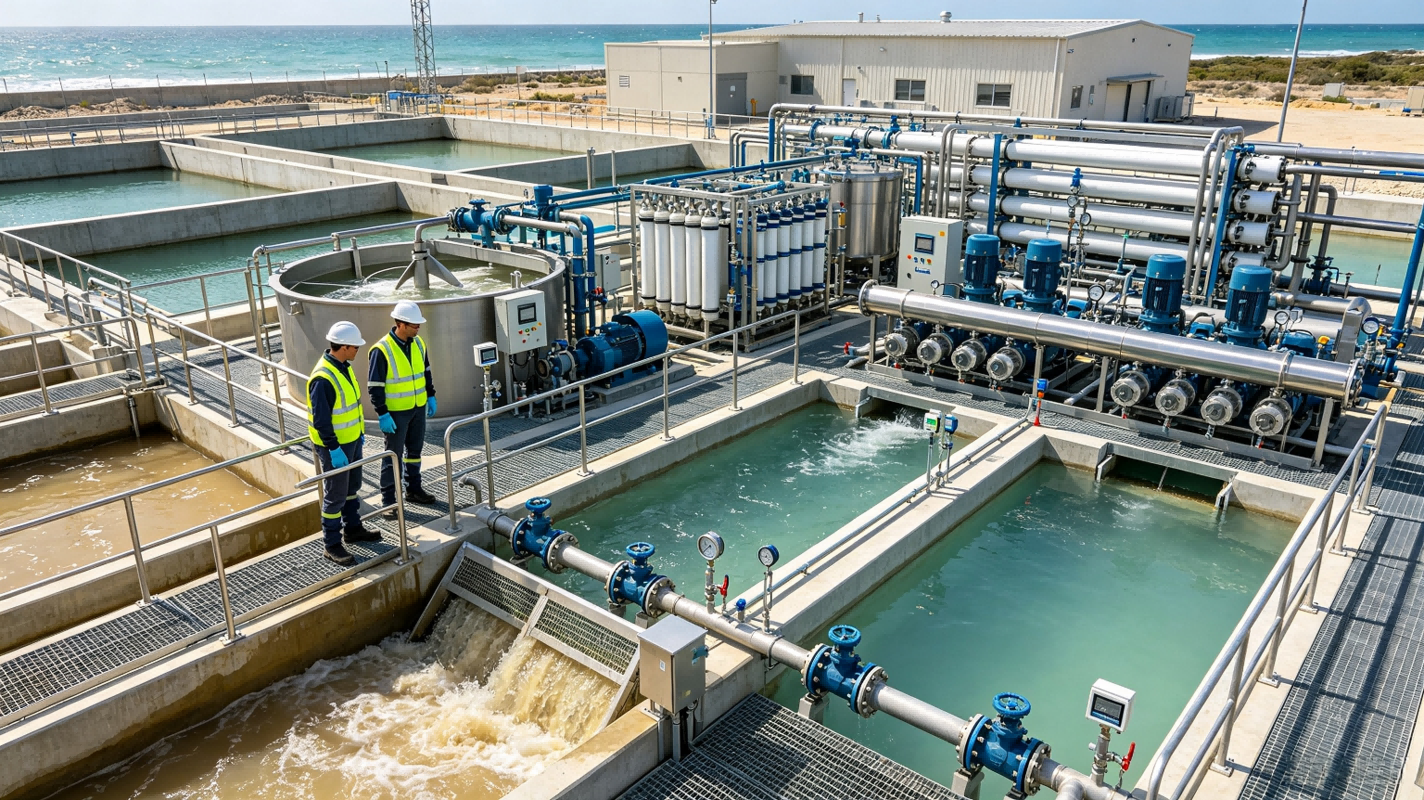
RO membranes have very small separation structures that allow water molecules to pass while rejecting dissolved salts.
However, suspended particles and organic materials in seawater can accumulate on the membrane surface and feed channels.
High turbidity may cause:
Membrane fouling
Increased differential pressure
Reduced permeate flow
Higher cleaning frequency
Shortened membrane service life
Increased operating costs
Because RO membranes are the core separation component of the desalination process, protecting them through effective pretreatment is essential.
Seawater turbidity can increase due to various environmental conditions.
Common causes include:
Heavy rainfall and coastal runoff can carry soil, sand, and organic materials into seawater.
Marine construction activities may increase suspended solids around seawater intake areas.
Seasonal algae growth can introduce organic matter and biological contaminants.
Nearshore seawater may contain more sediment compared with deeper offshore intake locations.
Waves, tides, and current changes can affect seawater quality.
Understanding the source of turbidity helps engineers select the most suitable pretreatment configuration.
Seawater Intake Design for High-Turbidity Conditions
The pretreatment process begins with seawater intake design.
A properly designed intake system can reduce the contaminant load entering downstream equipment.
Important intake considerations include:
Intake location
Water depth
Flow velocity
Seasonal seawater changes
Marine ecosystem conditions
Sediment concentration
Common seawater intake options include:
Open ocean intake systems collect seawater from offshore locations where suspended solids may be lower.
Advantages include:
More stable water quality
Lower turbidity variation
Reduced sediment loading
However, construction and maintenance requirements may be higher.
Subsurface intake systems use natural filtration through coastal sand layers.
Benefits include:
Reduced turbidity
Lower organic loading
More stable feed water quality
The suitability depends on local geological conditions.
Nearshore intakes are often easier to install but may experience higher turbidity.
Additional pretreatment capacity may be required for these systems.
Screening and Initial Filtration
The first stage of pretreatment usually removes larger particles.
Screening equipment protects pumps and downstream treatment units.
Typical components include:
Coarse screens
Fine screens
Automatic self-cleaning filters
These systems remove:
Large debris
Marine organisms
Floating materials
Larger suspended particles
Proper screening reduces the load on subsequent filtration equipment.
Coagulation and Flocculation Pretreatment
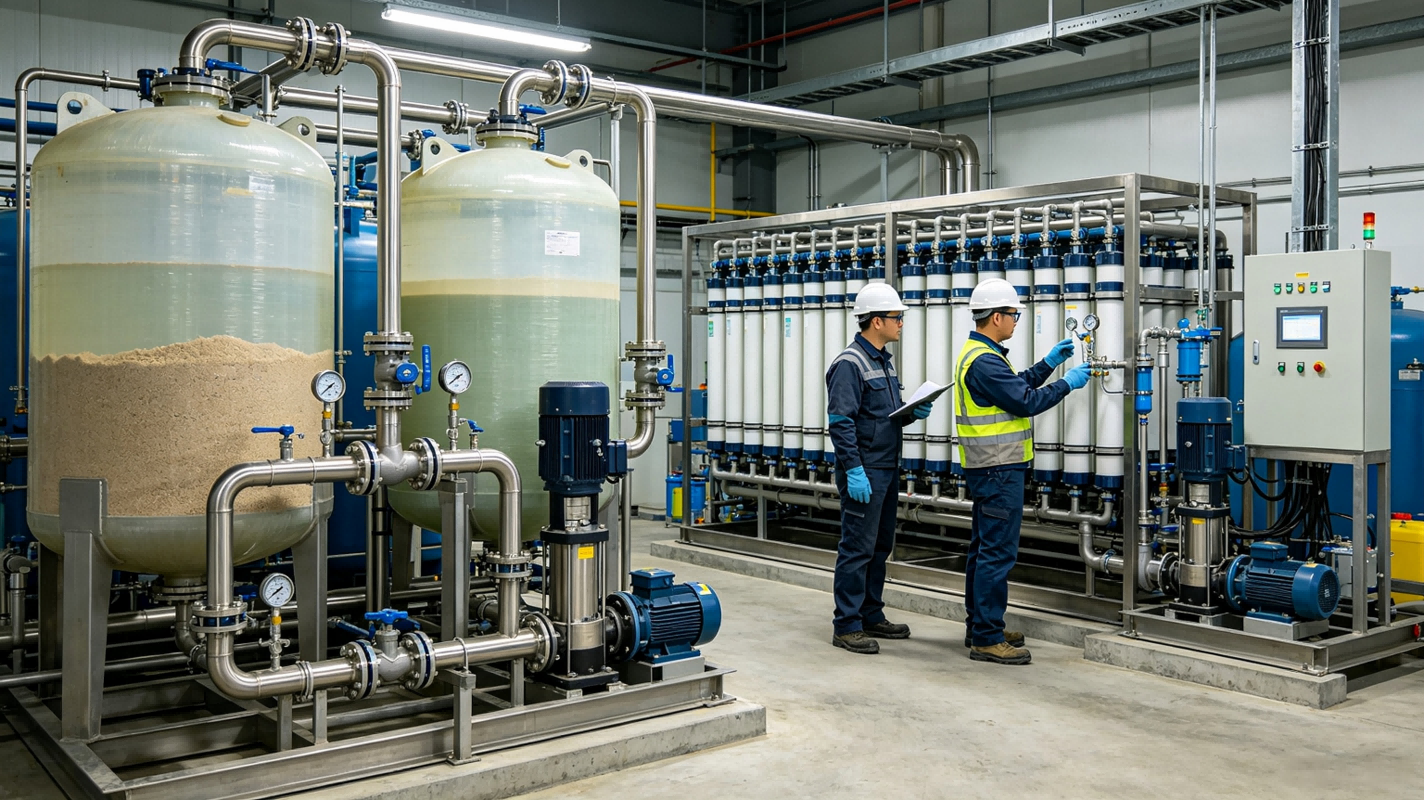
For high-turbidity seawater, coagulation and flocculation are often important pretreatment steps.
The process uses chemical agents to help small particles combine into larger flocs.
The basic process includes:
Chemical dosing into seawater
Rapid mixing
Floc formation
Particle aggregation
Removal through filtration or sedimentation
Coagulation helps remove:
Fine suspended solids
Colloidal particles
Organic matter
It can also improve downstream filtration performance.
Multimedia Filtration for Turbidity Reduction
Multimedia filtration is commonly used in SWRO pretreatment systems.
A typical multimedia filter contains several layers of filtration materials.
Common filter media include:
Anthracite
Sand
Gravel support layers
The filtration process removes:
Suspended solids
Fine particles
Turbidity-causing materials
Advantages of multimedia filtration include:
Simple operation
Large treatment capacity
Reliable performance
Suitable for variable seawater conditions
For high-turbidity applications, filter design parameters such as filtration velocity, media depth, and backwashing frequency must be carefully selected.
Ultrafiltration Pretreatment for SWRO
Ultrafiltration (UF) has become an increasingly common pretreatment technology for Seawater Desalination.
UF membranes provide a physical barrier for removing:
Suspended solids
Colloids
Microorganisms
Large organic molecules
Compared with conventional filtration, UF can provide more consistent feed water quality for RO membranes.
Benefits include:
Lower SDI values
Stable operation
Better membrane protection
Reduced impact from seawater fluctuations
UF pretreatment is especially useful in areas where seawater quality changes frequently.
Cartridge Filtration Before RO Membranes
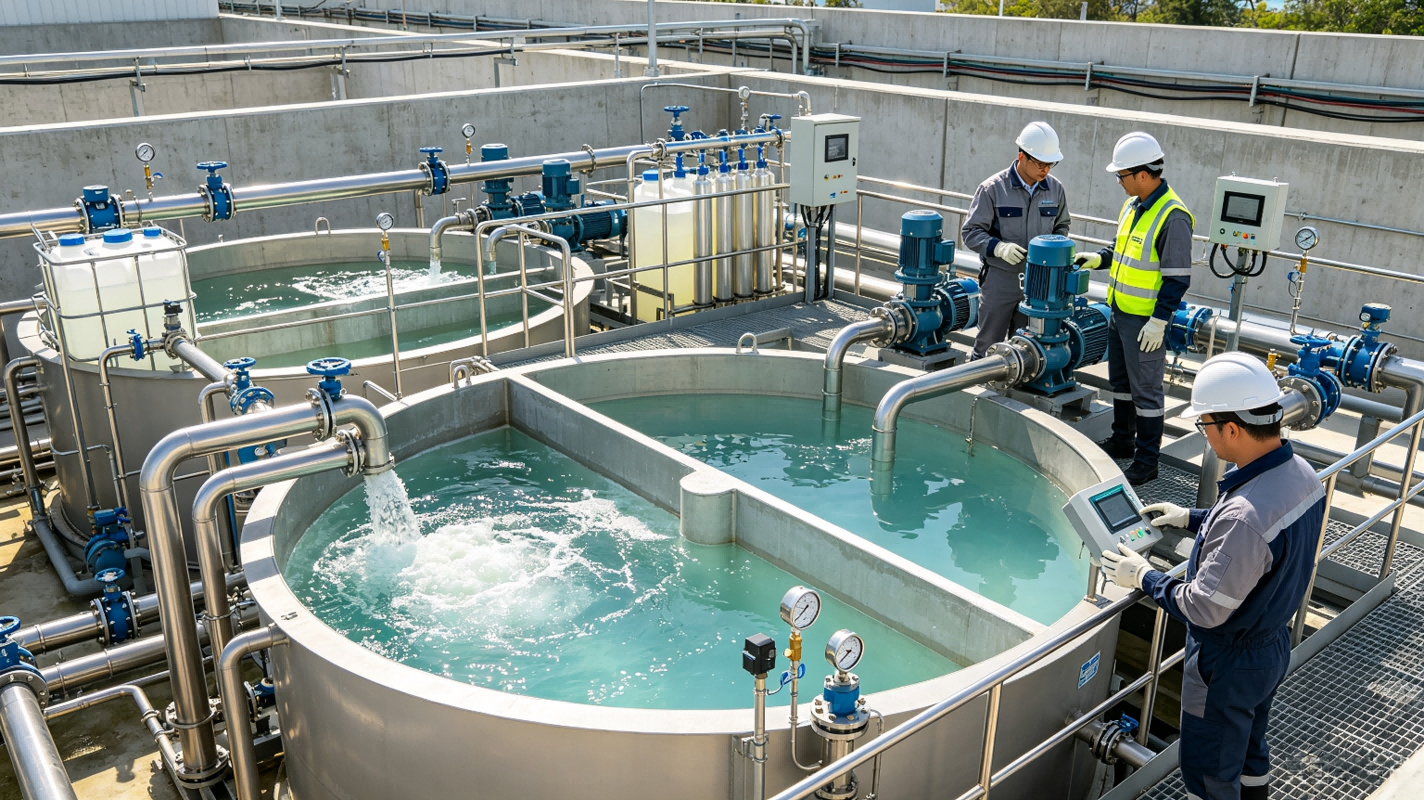
Cartridge filters are typically installed as a final filtration stage before the high-pressure pump and RO system.
Their main function is removing remaining fine particles.
Typical filtration ratings may vary depending on:
Pretreatment performance
Membrane requirements
Feed water conditions
Cartridge filtration helps protect:
High-pressure pumps
RO membranes
Flow control components
Regular replacement is important because clogged cartridges can increase pressure loss.
Chemical Dosing in High-Turbidity SWRO Pretreatment
Chemical treatment is often required to maintain stable SWRO operation.
Common chemical dosing applications include:
Used to improve particle removal during coagulation.
Used to reduce mineral scaling on RO membranes.
Used to control biological growth when appropriate.
Used to optimize treatment conditions.
Chemical dosing must be carefully controlled because excessive chemicals may affect membrane performance.
Pretreatment Performance Monitoring
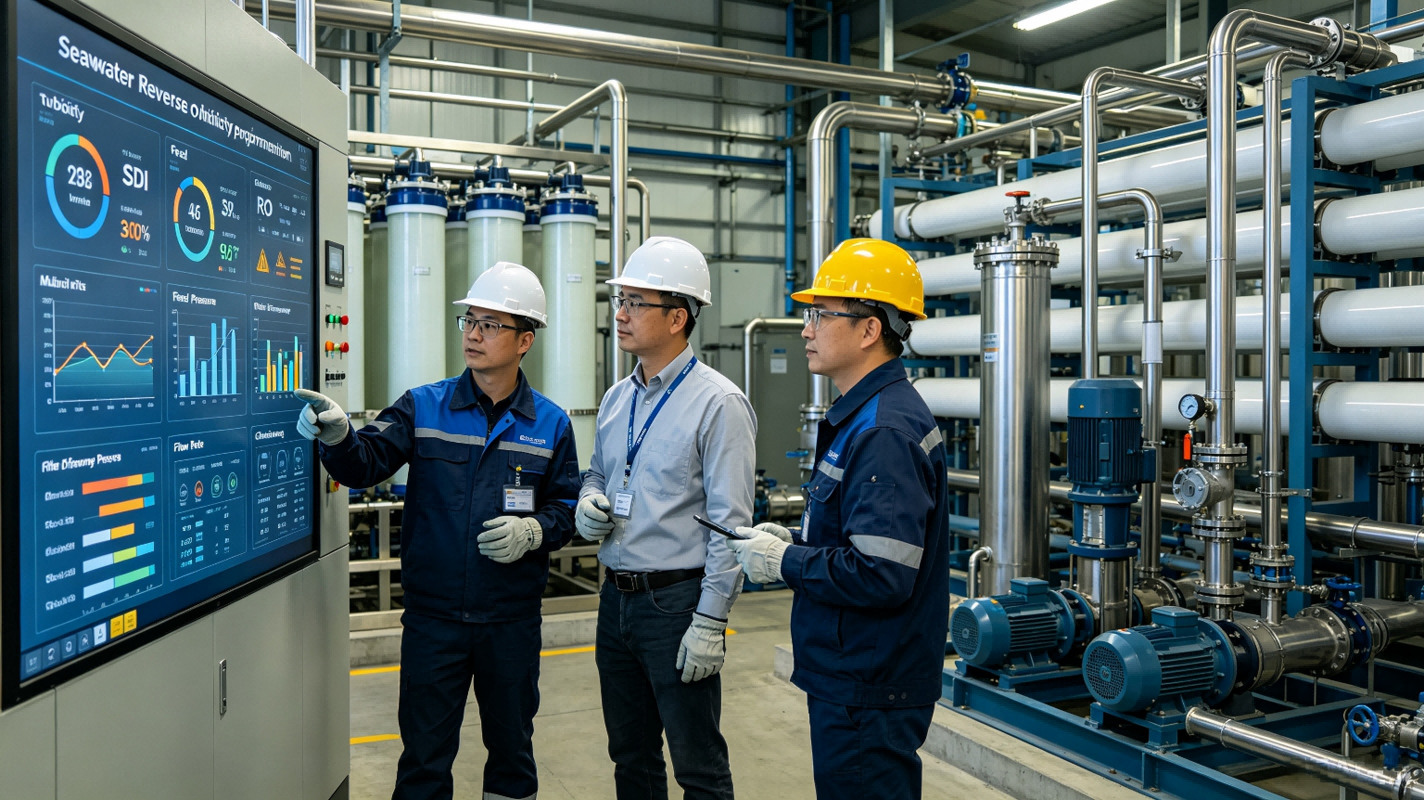
Continuous monitoring helps operators maintain stable SWRO operation.
Important parameters include:
Measures the clarity of seawater after pretreatment.
Indicates the potential of feed water to cause membrane fouling.
Shows pressure changes across filters and treatment units.
Helps confirm stable pretreatment operation.
Ensures proper treatment conditions.
Real-time monitoring allows operators to identify problems before they affect RO membranes.
Pretreatment Design Based on Seawater Conditions
There is no universal pretreatment design for all SWRO projects.
The configuration depends on:
Seawater turbidity level
Seasonal variation
Intake type
Required production capacity
Membrane selection
Operating strategy
Examples:
May require:
Screening
Cartridge filtration
Basic chemical dosing
May require:
Coagulation
Flocculation
Multimedia filtration
Ultrafiltration
Advanced monitoring
May require:
Flexible pretreatment combinations
Automated control
Additional filtration capacity
Engineering decisions should be based on actual water analysis rather than standard configurations.
Pretreatment and RO Membrane Performance
A properly designed pretreatment system directly affects RO performance.
Benefits include:
Removing suspended solids and organic matter reduces deposits on membrane surfaces.
Better feed water quality helps maintain consistent permeate flow.
Reduced fouling means fewer chemical cleaning procedures.
Stable operation helps protect membrane elements over longer periods.
Operation and Maintenance of Pretreatment Systems
Pretreatment equipment requires regular maintenance.
Common activities include:
Filter media inspection
Backwashing
Cartridge replacement
Chemical system inspection
Pump maintenance
Instrument calibration
Operators should monitor changes in:
Pressure drop
Turbidity
SDI
Flow performance
Early identification of problems helps prevent downstream RO performance issues.
Pretreatment Design for Remote and Offshore Applications
Remote locations create additional design challenges.
Examples include:
Islands
Offshore platforms
Marine vessels
Remote industrial sites
Pretreatment systems for these applications should consider:
Compact design
Simple operation
Reduced maintenance requirements
Corrosion resistance
Automated monitoring
Containerized pretreatment modules are often used where installation space and construction resources are limited.
Future Trends in SWRO Pretreatment
SWRO pretreatment technology continues to develop with improvements in:
Ultrafiltration systems
Automated control
Smart monitoring
Energy-efficient operation
Advanced filtration materials
Future systems will focus on improving reliability under changing seawater conditions while reducing maintenance requirements.
As seawater desalination expands, effective pretreatment design will remain one of the key factors determining SWRO system performance.
Conclusion
Pretreatment design is a fundamental part of high-turbidity seawater RO systems.
Because seawater quality can change due to weather, location, and marine conditions, engineers must develop pretreatment solutions that match specific project requirements.
Screening, coagulation, multimedia filtration, ultrafiltration, cartridge filtration, and chemical treatment each play important roles in protecting RO membranes.
A properly designed pretreatment system improves feed water stability, reduces membrane fouling, lowers maintenance requirements, and supports long-term SWRO operation.
For challenging seawater environments, effective pretreatment is not only a protective step before reverse osmosis but also a key factor in achieving reliable freshwater production from seawater.
Este site usa cookies para garantir que você tenha a melhor experiência em nosso site.
 English
 Pусский
 Français
 العربية
 ไทย
ไทย Indonesia
 Melayu
 Tiếng Việt
 中文
中文 қазақ
қазақ עִברִית
 မြန်မာ
 ພາສາລາວ
 Filipino
 o'zbek
 Кыргызча
 тоҷикӣ
 ខ្មែរ
ខ្មែរ Türkmenler



 Telefone
Comente
(0)